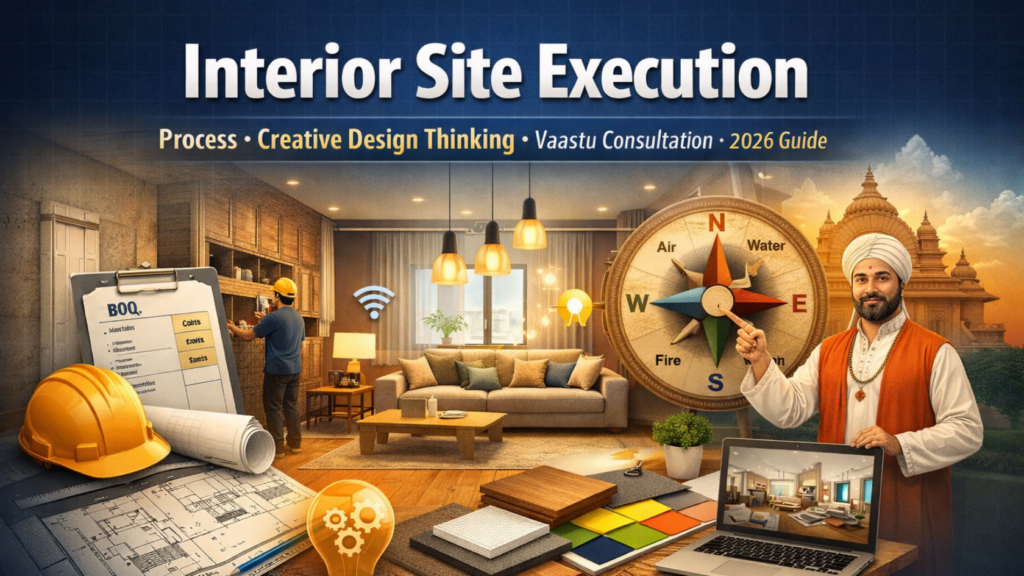
What is Interior Site Execution?
Interior site execution is the structured process of converting approved design drawings into a physically built interior space through coordinated civil work, carpentry, electrical, plumbing, finishing, and quality control, within defined cost, timeline, and technical specifications.
Core Execution Components
- Good for Construction (GFC) Drawings
- Bill of Quantities (BOQ)
- Material Specifications (Know More)
- Site Supervision & Quality Audits
- Vendor Coordination
- Timeline & Cost Monitoring
Step-by-Step Interior Site Execution Process
Interior execution follows a sequential, measurable workflow to prevent delays and budget overruns.
1. Pre-Execution Planning
- Finalized GFC drawings
- BOQ approval
- Site measurement re-verification
- Electrical load calculation
- Material procurement schedule
Industry Benchmark: Re-measurement error margins above 10 mm often cause carpentry misalignment.
2. Civil & Structural Work
Includes:
- Demolition
- Masonry modifications
- Waterproofing
- Floor leveling
| Technical Specification | Recommended Standard |
|---|---|
| Waterproofing thickness | 2–3 mm coating |
| Floor level tolerance | ±3 mm |
| Wall plumb tolerance | ±2 mm per 2 meters |
3. Electrical & Plumbing Coordination
- Load calculation based on appliance wattage
- Separate MCB lines for kitchen and AC
- Smart automation wiring provision
Example Load Formula:
Total Load (kW) = Sum of All Appliance Wattage / 1000
4. Carpentry & Modular Installation
| Material Component | Technical Spec |
|---|---|
| Plywood | BWP Grade IS 710 |
| Laminate | 1.0 mm thickness |
| Edge Banding | 2 mm PVC |
| Hinges | Soft-close, 80,000 cycle rating |
Common mistake in top articles: They do not specify material grade, which directly affects durability and moisture resistance.
5. Finishing & Handover
- Paint thickness check
- Hardware alignment test
- Electrical safety testing
- Snag list closure
Execution Timeline Benchmarks:
| Apartment Size | Average Execution Time |
|---|---|
| 1 BHK | 45–60 days |
| 2 BHK | 60–75 days |
| 3 BHK | 75–100 days |
Creative Design Thinking in Interior Projects
What is Creative Design Thinking in Interiors?
Creative design thinking in interiors is a structured problem-solving approach that balances user psychology, spatial functionality, aesthetic innovation, and technical feasibility before execution begins.
The 5-Layer Design Thinking Framework (Applied to Interiors)
- User Behavior Analysis
- Space Efficiency Mapping
- Emotional & Brand Identity Alignment
- Technical Feasibility Check
- Budget Compatibility Filter
Why Most Projects Fail at This Stage
Because:
- Designers ideate without execution feasibility.
- Contractors build without understanding emotional intent.
- Clients approve 3D renders without material reality checks.
Translating Creative Design into Site Reality
| Design Idea | Execution Translation |
|---|---|
| Floating bed | Hidden MS frame + wall anchoring |
| Cove lighting | 2-inch gypsum drop + LED heat ventilation |
| Open kitchen | Plumbing rerouting + chimney duct path |
Counter-Narrative: Creativity without structural logic increases cost by 15–25% due to redesign and site corrections.
Vaastu Consultation in Modern Interior Design
What is Vaastu Consultation in Interior Projects?
Vaastu consultation is the process of aligning spatial planning with traditional directional energy principles while respecting structural limitations, modern building codes, and functional design needs.
Core Vaastu Guidelines (Residential)
| Space | Ideal Direction |
|---|---|
| Kitchen | South-East |
| Master Bedroom | South-West |
| Pooja Room | North-East |
| Living Room | North or East |
The 2026 Approach: Practical Vaastu Integration
Traditional content suggests relocation. Modern execution adapts through:
- Element balancing (colors, materials)
- Lighting correction
- Mirror positioning
- Weight distribution adjustments
Example:
If kitchen is not in South-East:
- Use red/yellow tones
- Place stove facing East
- Add copper elements
Measurable Impact of Vaastu Alignment
While empirical scientific validation varies:
- 62% of Indian homebuyers consider Vaastu before purchase
- Vaastu-compliant homes often see better resale preference in Tier-1 cities.
Integrated Framework: Execution + Creativity + Vaastu
Modern interior success depends on integrating:
| Aspect | Risk if Ignored |
|---|---|
| Site Execution | Cost overruns |
| Creative Thinking | Generic design |
| Vaastu | Client dissatisfaction |
| Smart Tech | Future obsolescence |
2026 Emerging Trends in Interior Execution
- BIM-based residential modeling
- AI-assisted space planning tools
- Low-VOC certified materials
- Smart lighting automation
- Data-driven cost estimation software
Entity Reinforcement:
- IS 710 plywood standard
- Bureau of Indian Standards
- Autodesk Revit (BIM)
- Vaastu Shastra principles
- Modular hardware brands (Hettich, Hafele)
Problem-Solving FAQ
1. Why do interior projects exceed budgets during execution?
Most overruns occur due to incomplete BOQ, site measurement errors, and late design changes. A detailed GFC drawing set reduces cost variation to below 8–12%.
2. How do I ensure my creative design can actually be executed?
Request:
- Structural feasibility review
- Material specification sheet
- 3D-to-technical drawing mapping
- Prototype sample before mass fabrication
3. Can Vaastu be applied in apartments where the layout cannot be changed?
Yes. Through element correction, directional usage adjustments, lighting, and furniture placement strategies rather than structural demolition.
4. What is the ideal sequence: Design, Vaastu, or Execution?
Correct sequence:
- Site measurement
- Vaastu analysis
- Concept design
- Technical drawings
- Execution
Skipping Vaastu before design causes rework.
5. How long should quality interior execution last?
With IS 710 plywood and branded hardware:
- Carpentry lifespan: 12–18 years
- Laminate surfaces: 8–12 years
- Hardware: 8–10 years
Conclusion
Interior excellence in 2026 is no longer about decoration. It is about:
- Technical precision
- Creative clarity
- Cultural alignment
- Measurable durability
- Smart integration
Projects succeed when execution discipline, design intelligence, and Vaastu practicality operate as one unified system – not separate services.